

From classroom to congregation

Published: April 8, 2026
How the Journey program strengthens ministry in MCEC
This article originally appeared on the website of Mennonite Church Eastern Canada (MCEC) and is shared with permission.
By Christina Cox, MCEC Communications Assistant
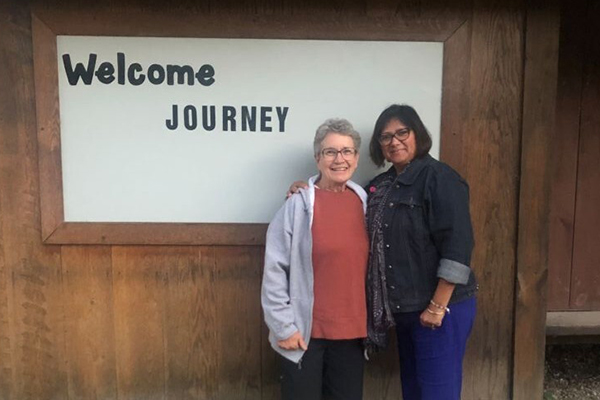
When Maciel Arias Hernandez of Toronto, Ontario, first began the Journey Missional Leadership Development Program of Anabaptist Mennonite Biblical Seminary in Elkhart, Indiana, she didn’t see it as a step toward personal achievement. Instead, she understood it as an invitation to listen more closely for God’s calling. It was an opportunity to deepen her theological understanding and strengthen her ability to help lead her congregation, Toronto Mennonite New Life Church.
“I love education,” Maciel said simply. “When you learn something nice, you want to share it with people you love.”
That impulse — to receive and then give — is at the heart of Maciel’s story and at the heart of why the Journey program has become such a meaningful partner in the work of Mennonite Church Eastern Canada (MCEC).
Maciel entered the distance-friendly Journey program in 2022, encouraged by trusted leaders in her congregation and supported through MCEC connections. At the time, her church was navigating life without a paid pastor, relying instead on lay leadership, deep commitment, and in Maciel’s words, “God’s grace.”
Like many lay leaders across MCEC, Maciel was already carrying a full load: working as a nurse, balancing family needs and living through the disruptions of the COVID‑19 pandemic. Over the next few years, she would also experience profound grief, including the loss of her mother. Looking back, Maciel said, “I don’t know how I did that, but God is great and gave me the strength.”
Rather than feeling like a drain on her precious time, the Journey program met her squarely in the middle of real life, Maciel said. Repeatedly, she found that what was being taught in her courses reflected what was unfolding beyond the classroom.
“Something parallel was happening in the world,” she observed, and often in her own life as well. She pointed to the echoes of early Anabaptist persecution and the violence unfolding in Palestine; lessons about the church’s response during the Black Plague alongside the realities of the COVID-19 pandemic; and more recently, the parallels she saw between Saul’s treatment of early Christians and the detention of people in the U.S.
The impact of the Journey program quickly reached beyond Maciel’s experience in the classroom. Almost immediately, she began bringing what she was learning back to her congregation. Courses on biblical interpretation gave her tools to read Scripture in context, to ask what a passage meant in its original setting and to faithfully “cross the bridge” into today’s realities. She is about to start an inductive Bible study with her congregation, sparking excitement and engagement.
“It was amazing how people responded,” she said. “They’re so excited to start.”
The program has also given Maciel the confidence to answer questions from newcomers to her congregation like, “What is your doctrine … what do you really believe?”
By grounding her leadership in Anabaptist history, theology and practice, Maciel found that she is better equipped to welcome new participants and nurture faith across generations. Children and youth are joining Bible studies alongside adults, asking questions and discovering what it means to follow Jesus in community.
“They are eager to learn about everything I’ve learned,” she reflected.

One of the Journey program’s strengths, Maciel believes, is its emphasis on inclusion, mentoring and spiritual care. Alongside academic learning, the program creates space for lament, healing and mutual support — essential elements for leaders serving in complex and often fragile contexts. This holistic approach reflects MCEC’s commitment to developing leaders who are not only knowledgeable, but also hopeful, vision-led and transformative.
Since her recent graduation, Maciel has continued to share what she has learned within her congregation, with other leaders and with anyone who asks about the program. She actively encourages others from diverse cultural backgrounds to consider Journey, confident that it offers both depth and accessibility.
Maciel’s story is one example of how partnerships between MCEC and theological institutions like AMBS strengthen congregations across our region. When leaders are equipped in context, while remaining embedded in their communities, the whole church benefits.
“You know, I feel blessed,” reflected Maciel. “I will never be the same again.”
Journey: A Missional Leadership Development Program is a distance-friendly undergraduate-level certificate program that develops leaders centered in Jesus Christ for ministries in local churches and communities. The program helps participants nurture their leadership abilities, grow in spiritual practices, and deepen their understanding of Anabaptist theology and ministry with the guidance of a dedicated pastoral mentor and experienced facilitators. The Fall 2026 cohort begins Sept. 11; those who apply by July 17 can save $100.
MCEC is a sponsoring conference of the Journey program at AMBS.
Want to receive AMBS news and updates via email?