

English-Cheyenne Dictionary goes home

Published: October 9, 2023

By Annette Brill Bergstresser
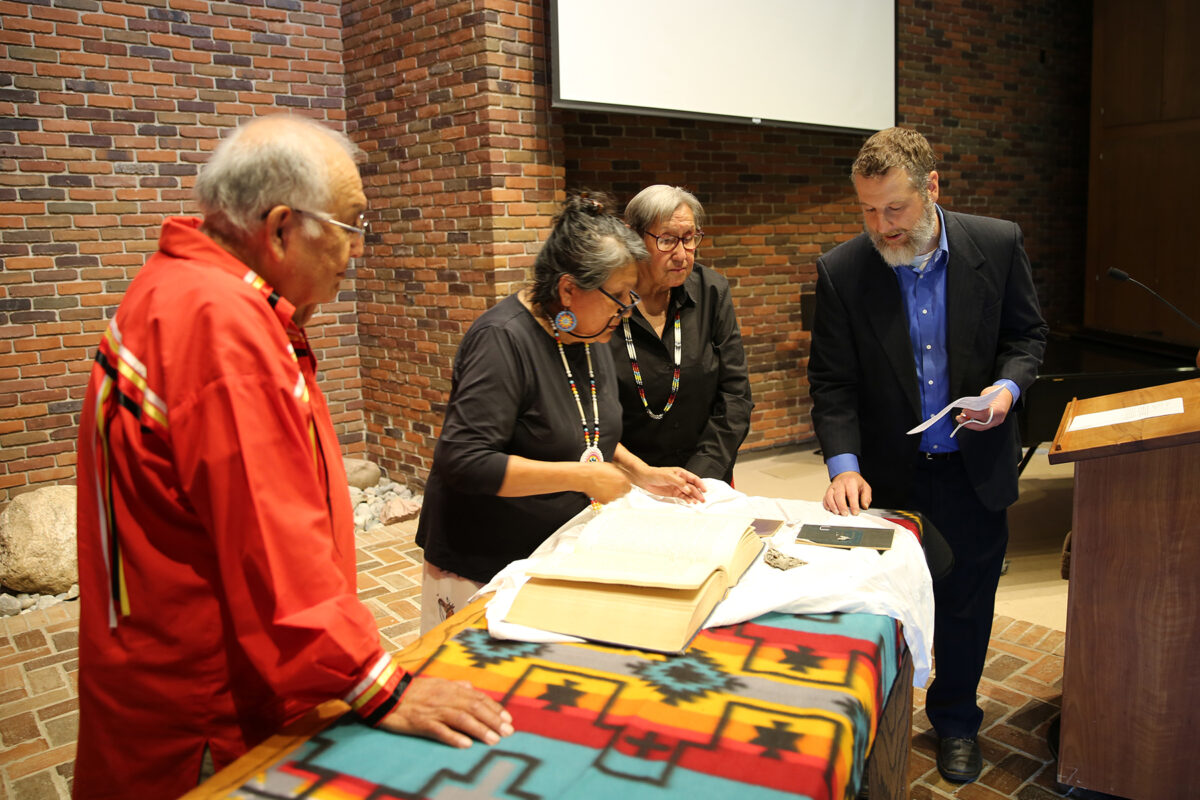
ELKHART, Indiana (Anabaptist Mennonite Biblical Seminary) — A rare copy of the 1,126-page English-Cheyenne Dictionary, published in 1915 by General Conference Mennonite missionary Dr. Rodolphe Petter, has been returned to the Southern Cheyenne Mennonite community where it originated.
In a special transfer ceremony on Oct. 3, 2023, in the Chapel of the Sermon on the Mount at Anabaptist Mennonite Biblical Seminary (AMBS) in Elkhart, Indiana, seminary leaders returned the dictionary and two copies of Zistxuistō, a rare Cheyenne Reading Book published by Petter in 1895, to Rev. Susan Hart, pastor of Koinonia Indian Mennonite Church in Clinton, Oklahoma.
Accompanying Hart at the seminary to receive the materials were her uncle, Dr. Richard Littlebear, retired President of Chief Dull Knife College in Lame Deer, Montana; and Elder Wilma Redbird of the Southern Cheyenne community in Oklahoma.
“It is with honor and humility that we return these rare and precious books to their rightful owners,” said Beverly Lapp, EdD, AMBS Vice President and Academic Dean, as she handed the books, wrapped in white cloth, to Hart. “May this dictionary, full of words and definitions, full of relationships between words and their meaning, and full of potential for learning and discovery and delight, bless the Koinonia Indian Mennonite Church and all whom you relate with now and in the future.”
After accepting the books on behalf of her community, Hart expressed gratitude and spoke of the importance of passing Cheyenne language and cultural traditions on to generations to come. She named the books’ role in connecting generations with one another.
“This dictionary isn’t the Bible,” she told members of the AMBS community at the ceremony. “But what it is are the voices of elders we’ve never met. We know what they spoke. We know how they reverenced Christ. We know how they reverenced God. We know how they reverenced the heavens.”
“The church is honored and the people are honored by this wonderful gift,” she continued. “We’ll go on preaching the Word of God on this wonderful journey.”
The dictionary’s story

According to Karl Stutzman, MLS, Director of Library Services, only 100 copies of the English-Cheyenne Dictionary were ever printed. Ancestors of the Southern Cheyenne Mennonites in Oklahoma collaborated with Petter; his wife, Bertha (Kinsinger); and son, Valdo; in the late 19th and early 20th centuries to create it. Stutzman noted that the creation of the dictionary was interwoven with the process of translating the Bible into Cheyenne.
“This copy has been in the AMBS Library’s special collections for generations, donated by a friend of the seminary and lovingly cared for by AMBS librarians,” he said during the ceremony. “But in fact, the book states inside that it was ‘Printed entirely in the interest of the Mennonite Mission among the Cheyenne Indians of Oklahoma and Montana.’ In other words, it was intended to be used in a Cheyenne Mennonite church in Oklahoma, rather than in a seminary library in Indiana.”
According to Hart, Koinonia Indian Mennonite Church is the oldest Indigenous Mennonite Church in North America. It was founded in 1894 by Petter and his first wife, Marie (Gerber), who came to the U.S. from Switzerland in 1890 to serve with the General Conference Mennonite Church Mission Board. Today, the congregation is part of Western District Conference of Mennonite Church USA.
“The Petter English-Cheyenne Dictionary is a tribute to Rodolphe Petter’s mission work with the Cheyenne people, and his unfailing devotion to Ma’heo’o [God] is an understatement,” Hart said. “[To express] our own gratitude for AMBS’s gift: Nea’ese [thank you].”
Referencing Matthew 18:20, she continued, “For Tse-‘o-noo-me-me-noto [he has called us] together in his name; ‘there am I with them.’”
Spirit-led connections pave the way

The story of the historic book’s current journey began with a visit by Teresa Martin, now a first-year AMBS Master of Divinity student from Norman, Oklahoma, to Sunday services at Koinonia Indian Mennonite Church in July 2023. She observed how Ma’heónevé’ho’e (Reverend) Hart led her congregation, especially the youth — integrating the Cheyenne language in teaching the Scriptures and hymns. Martin approached Hart to learn more.
“Rev. Hart and I have had multiple discussions over the past months surrounding her commitment to preserving the Cheyenne language and culture for the youth and future generations to come,” she said. “With her help, I have committed myself to learning more about their history, language and culture.”
Hart, who is also a member of Mennonite Church USA’s Executive Board and a delegate of Native Mennonite Ministries (a constituency group of Mennonite Church USA), noted the challenges her community faced.
“The forced absence of families and extended families through federal and state policies — compounded with social issues such as poverty, addictions and poor health — have led the way to the loss of spirituality and quite profoundly, the loss of the Cheyenne language — thus their own identity as a people,” she said.
Upon arriving at AMBS in August 2023, Martin inquired about Cheyenne materials in the seminary library’s collections. After Stutzman showed her the library’s copy of the dictionary, she helped him contact Hart to explore the possibility of returning the dictionary to the Koinonia congregation. Through videoconference meetings, Hart and Stutzman developed a plan for the return ceremony together.
![The 1,126-page English-Cheyenne Dictionary and two copies of Zistxuistō [Cheyenne Reading Book] that were returned to the Southern Cheyenne Mennonite community in a special transfer ceremony on Oct. 3 at Anabaptist Mennonite Biblical Seminary, Elkhart, Indiana. (Credit: Abenezer Dejene)](https://ambs.edu/wp-content/uploads/2023/10/AMBS-English-Cheyenne-Dictionary-and-other-volumes-9195-6x4-1-1024x683.jpg)
“Through some professional education in recent years, I have learned that a traditional Indigenous understanding of ownership of a book relates to whose knowledge is contained within its pages,” said Stutzman. He noted that Article 31 of the United Nations Declaration on the Rights of Indigenous Peoples, adopted in 2007, asserts that Indigenous peoples have the “right to maintain, control, protect and develop their cultural heritage, traditional knowledge and traditional cultural expressions.”
“Because the traditional knowledge of language and culture contained within this dictionary have belonged all along with the Cheyenne congregations of the Mennonite Church, which are still practicing today, it was only right to return it to our brothers and sisters in Oklahoma,” he said.
Martin commented on the connections created throughout the process: “Each connection that allows more actors to participate in preserving and recovering important voices from the past allows healing and peace to begin among our Indigenous sisters and brothers. Ma’heo’o [God] used me to connect the two main actors for this event — AMBS and Koinonia Indian Mennonite Church.”
The power of language and story
Following the transfer of the books, Littlebear, who is an authority on the Cheyenne language, spoke of the power of language and the value of preserving it, noting that the dictionary is one of his favorite books to read.
“When reading our dictionary, often I will come to a word that is no longer in use,” he said. “I think, ‘Oh, this is how it was used.’ It’s just a really good experience to relive that. I can smell the sagebrush; I can smell the wild cedar and the meat that was being cooked.”
He added that the dictionary provides a foundation for learning and understanding the Cheyenne language and culture, including its spirituality and humor.
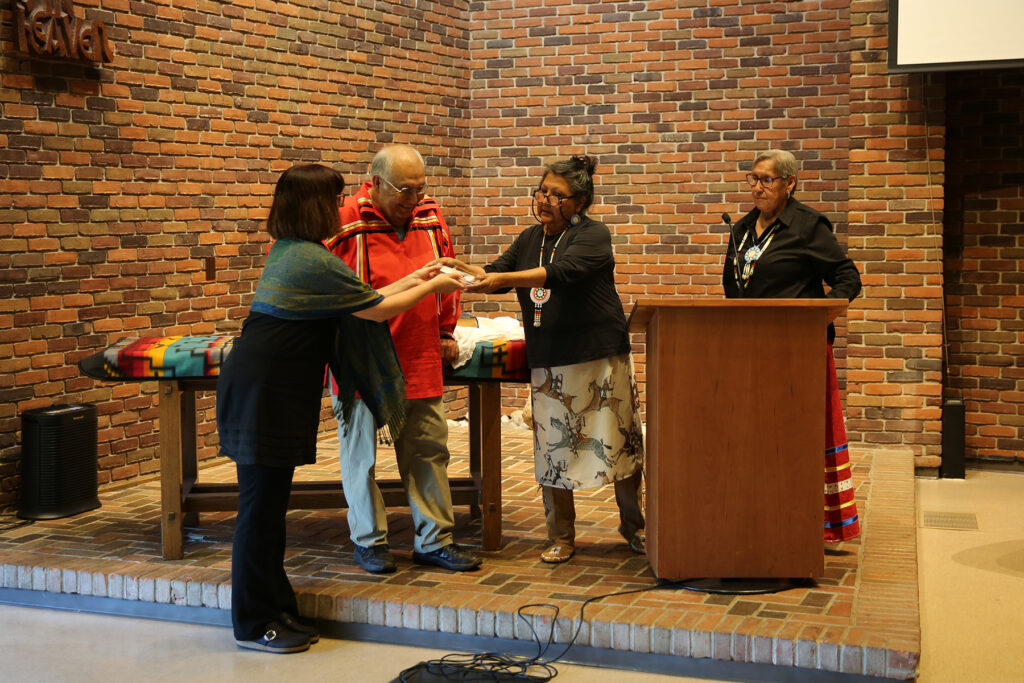
The transfer ceremony included prayers and hymns in both Cheyenne and English. Hart also presented gifts of hand-beaded crosses that illustrate the church’s Indigenous culture and spirituality to Boshart, Lapp, Stutzman and Martin. David Boshart, PhD, AMBS President, who could not attend the ceremony due to prior travel plans, recorded a greeting to be shared at the event.
Following the event, Stutzman and Hart reflected on the impact of returning the books.
“I like to tell people who visit our library about the power of the voices represented in our library’s collections, speaking from the past into the present and future,” said Stutzman. “I used the dictionary to tell visitors about the power of preserving Indigenous languages through the process of Bible translation and about the incredible intricacy of the Cheyenne language. But I’m even more pleased to tell a new story about these voices going home to their people.”
Hart said, “It is critical to the life of the church and our mission to take proactive efforts in singing our hymns and saying our Scriptures in our own language. It helps to heal generational trauma by bringing us closer together and above all closer to Ma’heo’o. Our Cheyenne prayers and songs still float above the plains to the he’amo’omēē’e [heavens].”
Located in Elkhart, Indiana, on ancestral land of the Potawatomi and Miami peoples, Anabaptist Mennonite Biblical Seminary is a learning community with an Anabaptist vision, offering theological education for learners both on campus and at a distance as well as a wide array of lifelong learning programs — all with the goal of educating followers of Jesus Christ to be leaders for God’s reconciling mission in the world. ambs.edu
Want to receive AMBS news and updates via email?