

Church leaders explore “Resistance, Resilience, Rest” at annual conference

Published: March 12, 2026
By John Longhurst for AMBS
ELKHART, Indiana (Anabaptist Mennonite Biblical Seminary) — What do resistance, resilience and rest look like for Anabaptists at a time like this? That was the focus of Pastors & Leaders 2026, held Feb. 23–26 at Anabaptist Mennonite Biblical Seminary (AMBS) in Elkhart, Indiana.
The conference on “Resistance, Resilience, Rest,” drew around 190 in-person and 15 online participants from across the U.S. and Canada.
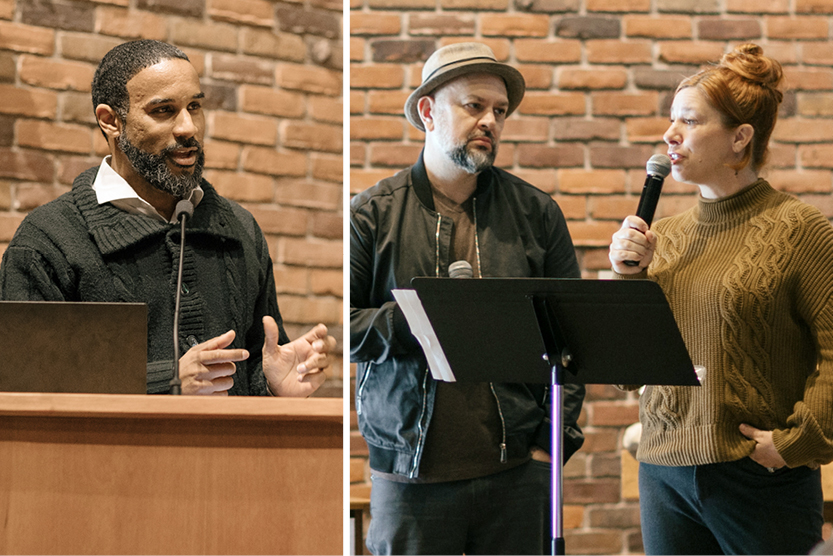
Speakers included Drew Hart, PhD, an author, educator and speaker from Harrisburg, Pennsylvania; and Dan White, Jr., MA, and Tonya White, pastors, counselors, authors and co-founders of the Kineo Center in Puerto Real, Puerto Rico.
Resistance
Drew Hart, Associate Professor of Theology at Messiah University in Mechanicsburg, Pennsylvania, presented two teaching sessions: “Resistance in the Mirror of the Fugitive and the Martyr” and “Prophetic Discipleship: Nonviolently Resisting and Organizing from Below.”
“What are the expectations of the empire that we have been handed?” he asked in his first presentation. “Are we willing to subvert it — to preach, mentor and disciple folks into the liberating presence and activity of Jesus?”
For Hart, resistance to empire doesn’t begin with protest marches and petitions. It begins with repentance, which starts when leaders and congregations ask how they have allowed themselves to be co-opted by the state.
“When we repent, we acknowledge that Jesus is Lord, which is a subversive way of declaring that Caesar, or the modern nation-state, is not,” he said. “Jesus sets us free so that we can live as citizens of God’s reign on the earth right now.”
White Anabaptists in particular must grapple with having maintained political quietism in the face of mass incarceration, inequities for accessing resources and opportunities, and persisting systemic poverty, Hart said.
“We cannot claim to be a peace church simply because we refuse to join the military,” he said. “Biblical peace is much more robust than that. Shalom is not the absence of tension; it is the positive presence of God’s justice, righteousness, joy, security and interdependent thriving.”
Hart suggested viewing the “peace church” label not as a badge of honor but as an aspirational goal. Becoming a peace church means actively resisting that which comes to steal, kill and destroy; dismantling White supremacy; taking up the cross and accepting the risks of clashing with the establishment.
Repentance signifies “partnering with God to be stolen away from the empire,” he added, so as to join the liberating ways of Jesus: redistributing wealth, standing in solidarity with oppressed and vulnerable people, and refusing to conform “to the death-dealing patterns of this world.”
In his second presentation, Hart provided practical examples for resisting Christian nationalism and threats to democracy — including bearing witness in the public square. To illustrate the challenge, he compared it to going up a down escalator.

“Setting our eyes on God’s shalom means to keep pressing forward, even when it’s tiresome — keeping our eyes set on that prize, realizing that sometimes there are folks going in the opposite direction,” he said. Because the escalator keeps moving, people can’t opt out and be neutral, he added.
Along with grassroots efforts like supporting food pantries, working with people who are unhoused, and addressing the root causes of poverty, Hart said that social change involves helping people discover their power — something Anabaptists have been reluctant to talk about, equating it with hierarchical power or domination. But the power Jesus talks about is different.
“How do we ignite not only our own agency, but also help other people recognize their agency, power and ability to act?” he said. “We need to reimagine power as dispersed, shared power with others.”
Anabaptists also need to seek both faithfulness and effectiveness, Hart said, noting that loving one’s neighbors means wanting to see a change in the conditions that negatively impact them: “When faithfulness and effectiveness come together, that’s a magic space where we can actually make a difference.”
Resilience and rest
Dan and Tonya White, who co-founded the Kineo Center in Puerto Rico to help leaders recover from burnout, presented teaching sessions on “Facing Our Weariness and Woundedness” and “Stepping Towards Health and Wholeness.”
In their first presentation, the Whites said that talking about resilience involves looking at what is actually preventing resilience.
Tonya White noted that cars have indicator lights that let the driver know when there’s a problem. But leaders often ignore warning lights that signal trouble in their spiritual, emotional and relational lives that can push them to the brink of burnout.
The concept of burnout is relatively modern, she said. Psychologist Herbert J. Freudenberger coined the term in his 1974 paper, “Staff Burn-Out.”
“This was recognized as a starting point for understanding burnout as an actual medical condition,” she said. “But it wasn’t until May 2019 that burnout received official recognition as a diagnosis from the World Health Organization. It was categorized as a condition stemming from chronic internal stress that remains unmanaged.”
The Whites said that responding to one’s “indicator lights” is not primarily about working less, getting more pay or taking a sabbatical.
“The primary reason for burnout is emotional and relational distress,” said Dan White. He noted that while many ministry leaders try to power through the challenges, doing so will lead to a breakdown, as it would for a car.
The Whites identified four indicator lights for leaders to pay attention to: relational injuries, vocational disappointments, dysregulated emotions and internalized expectations. When these lights are ignored, the stresses can erode the joy leaders feel in their calling, Dan White said, noting that free burnout prevention resources are available on their ministry’s website.
In their second presentation, the Whites spoke about five “bricks,” or foundational needs, that make up everyone’s life and help them feel stable and secure.
“We typically don’t look at our foundations until something is off, which is sad,” Dan White said. “We actually should understand that things are draining us, burning us out and preventing resilience because something underneath our feet — our foundation — is fragile.”
For the Whites, those foundational bricks include belonging, safety, significance, agency and understanding.
“At some point, you cracked one or two of these bricks,” Dan White said. “And now, for the rest of your life, it is the most sensitive and susceptible part of you.”
In ministry, those cracks can intentionally or unintentionally be poked, he said, leading to problems. The challenge for ministry leaders is to understand which of their bricks are cracked, when these breaks happened, and how the cracks are showing up in their ministries. How might leaders be protecting or projecting their wounded areas?
Dealing with these cracks can promote resilience, the Whites said, defining it as the ability to recover from difficult circumstances. No one can foresee what circumstances they’ll face, they added, but by bringing their cracks out of the shadows, they can start to find healing.
Worship
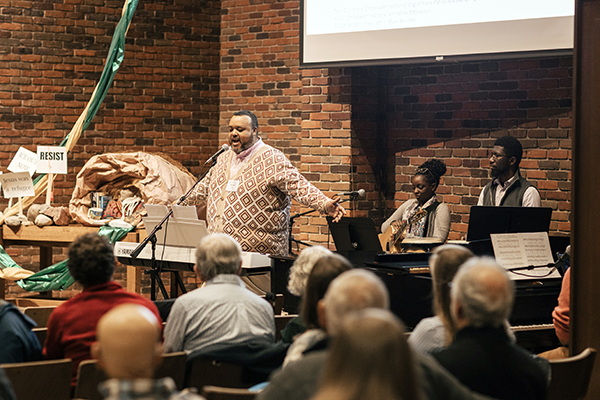
In addition to the teaching sessions, the conference included daily times of worship, prayer and movement. Participants could reflect on their experiences together in small groups and choose from 28 workshop options on topics connected with the theme.
Kristin Loeks Jackson, MDiv, Pastor of Living Water Community Church in Chicago, Illinois, and Regina Shands Stoltzfus, PhD, Professor of Peace, Justice and Conflict Studies at Goshen (Indiana) College, preached during worship sessions on the second and third days of the conference, respectively.
Rashard Allen, DWS, Director of Music and Worship at Neffsville Mennonite Church in Lancaster, Pennsylvania, served as Worship Leader for the event, accompanied by members of the AMBS learning community and conference participants.
Pastors & Leaders 2027 will be held Feb. 22–25. The annual conference is hosted by AMBS’s Church Leadership Center.
John Longhurst is a freelance writer in Winnipeg.
Located in Elkhart, Indiana, on ancestral land of the Potawatomi and Miami peoples, Anabaptist Mennonite Biblical Seminary is a learning community with an Anabaptist vision, offering theological education for learners both on campus and at a distance as well as a wide array of lifelong learning programs — all with the goal of educating followers of Jesus Christ to be leaders for God’s reconciling mission in the world. ambs.edu
Want to receive AMBS news and updates via email?